Wednesday, July 17, 2013
10/11 News Central Nebraska Story on NEH Trip to Istanbul
Here's a story that aired on the evening of July 16, 2013 regarding my National Endowment for the Humanities Summer Institute in Istanbul.

Friday, July 12, 2013
Ramadan Reflections
 |
| Picture taken at sunset on the first night of Ramadan. |
Ramadan, the ninth month in the Islamic calendar, serves as month of fasting, prayer, and sacrifice for Muslims around the world. As one of the Five Pillars of Islam, it lies at the heart of Muslim tradition. The dates of this month change from year to year on the Gregorian calendar due to the Islamic calendar's foundation in lunar phases which means that Ramadan moves roughly eleven days earlier each year. This year in Istanbul, Ramadan started at sunset on Monday, July 8.
Since finding out that I would be traveling to Istanbul, I have been absolutely thrilled with the prospect of being in Istanbul for the first few days of Ramadan. Ramadan is something that is discussed in the classes I teach and students always have lots of questions about how Ramadan works. In the past, I have taught my students the fundamentals, as I best understood them. Basically, I focused on the fact that many Muslims abstain from eating and drinking from sunrise to sunset during the month of Ramadan. Many try to eat and drink something before sunrise and the beginning of morning prayers, as well as break the fast with large family or community meals after sunset. Ramadan is a month of prayer, fasting, and avoiding other vices and sinful practices. More than anything else, it is an opportunity to sacrifice, practice self-control, develop greater awareness of the challenges of the poor and hungry, and deepen one's personal relationship with God.
Students are always fascinated with the challenges of such a lengthy period of daily fasting. In particular, they realized that depending on the calendar, Ramadan can fall during the long daylight hours of the summertime (like this year) or require significant shorter days of fasting in the winter. We do discuss that fasting is something that can be found in many world religions and also draw the parallel between Ramadan and the fasting/sacrifices of the Lenten season in the Christian tradition.
However, the reason that I wanted to write this blog entry is due to the fact that I've learned so much about the culture and customs that surround the month of Ramadan here in the Istanbul area. Here are some observations:
- Ramadan creates an incredible sense of community. This becomes clear when one witnesses the iftar or fast-breaking meal. As sunset nears, people begin to gather in parks, squares and other communal spaces throughout the city to share in a meal together. Many bring a picnic dinner and have everything set out and ready for when the local mosque or TV announces that the fast has ended for the day. For many, the first thing they do is open a bottle of water and drink for the first time in 15-16 hours. It has been profoundly moving to watch hundreds or even thousands of families begin eating and drinking at exactly the same time. In addition to families, I've seen construction coworkers, waiters, and others working together prepare and break the fast together before they get back to their duties.

Thousands breaking the fast together in the Hippodrome.
- Ramadan entails a tremendous degree of sacrifice, but also incorporates a feeling of celebration each evening. It is very cyclical in that sense. This appears to be one area wherein the Christian season of Lent and Islamic season of Ramadan differ. Lent is a 40-day linear season of sacrifice and prayer that leads to Easter, while the cycle of fasting/breaking fast occurs each and everyday during Ramadan. That distinction being drawn, it is important to note that Ramadan and Lent share much in common with regards to being seasons of increased prayer, attention to proper behavior, and increased attention given to charitable works and contribution.


- While I can't comment on other cities throughout the Islamic world, the mosques, public spaces, and businesses of Istanbul very much embrace Ramadan with formal celebration. I've witnessed the lights hung on the minarets of mosques around the city, as well as the lights spelling holiday greetings that span the space between minarets. I've seen public spaces in the hippodrome and at Taksim Square where massive iftar feasts have been prepared to feed thousands. Nearly every green space in the city is prepared for the picnics of families. There is even a craft market that opened in the Hippodrome during Ramadan full of artisan crafts, baklava, Turkish Delight, ice cream, and other snacks. On Istiklal Street, a trolley transports "Ramadan Rock Bands" up and down the street to entertain people. Near my hotel, a small amphitheater presents concerts or other entertainment programs each night. Finally, restaurants throughout the city may be a bit slower throughout the day as people are fasting, but many have special iftar fixed menus that include soup, bread, dates, olives, salad, rice, meat dish, desert, and tea for a set price. Even fast food restaurants like McDonald's make special accommodations during Ramadan to open at 2:00am or 3:00am in the morning so that people can eat before the sun rises.
 |
| Entrance to the Craft Bazaar on the Hippodrome. |
 |
| Soup, salad, and appetizer portion of a fixed menu iftar meal at a cafe on Istiklal Street. |
 |
| Part of the iftar fixed menu meal I had included Kofte (lamb and beef meatballs). |
 |
| McDonald's make accommodations throughout the city to open early enough for people to eat before the fast begins. |
In witnessing the first few days of Ramadan here in Istanbul, I have to say that I have a whole new appreciation for the depth of sacrifice, but also the incredible sense of togetherness and celebration brought about by the season.
Thursday, July 4, 2013
Hagia Sophia: Church? Mosque? Museum?
 |
| Hagia Sophia |
In 532 A.D., Emperor Justinian began the process of building arguably the greatest structure of late classical antiquity. Even more astounding is that the Hagia Sophia or Church of Holy Wisdom was completed in only five years. Since then, this structure has seen the rise and fall of empires, as well as weathered the forces of nature for nearly 1500 years. It's dome has collapsed and been replaced due to earthquake, while the immense weight of the building has required massive reinforcement.
 |
| Buttresses added later to support massive walls and domes. |
In addition to the structural challenges this building has faced, the historical transition from the Byzantine Empire to Ottoman Empire to the modern state of Turkey has seen this building undergo massive change in use throughout the years. During the Byzantine era, it stood as one of the greatest churches in all of Christendom. However, in 1453, Mehmet II the Conqueror defeated what was left of the Byzantine resistance and began establishing his imperial capital in the city. Hagia Sophia was indeed a great treasure, so he converted the building to a mosque, preserving much of the original architecture, but adding minarets, and over time, many of the legendary Byzantine mosaics were covered as Arabic calligraphy and Quranic verse became the ornamentation of choice within it's soaring walls and domes. Finally, after the fall of the Ottomans shortly after World War I and the establishment of the modern state of Turkey under Mustafa Kemal (Ataturk), the Hagia Sophia's role changed once more into that of a secular museum that sought to preserve the best of all previous traditions.
 |
| Christian and Islamic features are present throughout the Hagia Sophia. |
 |
| Scaffolding draws attention to current restoration efforts. |
Tuesday, July 2, 2013
Watching the World Go By at Pierre Loti
 |
| A small lull in the pedestrian traffic as the tram goes by the cafe where I'm working. |
After being here for about ten days, I feel like it is possible to be a bit more reflective about what I've seen and experienced. This post may seem like a wide variety of disconnected ideas, but here are some observations from the last week and a half in Istanbul.
Ability to Navigate (and Function) within the City
Istanbul is a chaotic, busy, and frequently loud place. Upon arrival last week, the sheer masses of people, as well as the constant barrage of hawkers promising terrific deals on carpets, souvenirs, or food, made one wonder if there was any peace to be found within the city. It felt like you couldn't walk five feet without being literally asked in a good-natured way, "How can I rip you off today, sir?".
Fast forward to today...the geography of the city lends itself to incredible walk-ability provided one avoids the trams, cars, pedestrians, and other obstacles. Distances across various parts of the city are not vast. In addition, the great mosques, monuments, and the sea provide excellent landmarks to orient oneself. As my mental map of the city has become increasingly refined, I've noticed that the hawkers pay less attention to me as I walk with far more of a purpose than earlier in the program.
Good Nature and Humor
I truly have encountered incredible hospitality throughout the city. While many times outreach may be tied to the prospect of financial profit, I have found the assistance to be rather genuine. A friend of mine in this program wanted to buy a public transit card, but didn't know where to purchase one. She asked a young man, and he escorted our group to several small shops that were supposed to sell them. Each one was sold out, but he persisted until we found the card she was looking for. He stood to gain nothing in this venture, but just wanted to help. I've seen museum security guards sneak into and "photobomb" pictures, smiling and laughing the entire time. I've also seen these same museum guards invite small children to play and splash in small fountains. Hoping to share in this spirit, I felt like I'd achieved pseudo-local status today when I helped a tourist find where he was at in the city.
Plain, Unsweetened Yogurt: The Perfect Compliment to Kebab!
 |
| Chicken kebab wrapped in bread with tomatoes, peppers, and yogurt |
Throughout this trip, I've tried eat as wide a variety of dishes as possible. It took over a week, but I've finally discovered the wonders of plain, unsweetened yogurt on seasoned lamb or chicken. Think of it as a slightly more healthy (I hope!) sour cream covering everything. Does it get any better? The food has been fantastic, and I couldn't be more happy to have another week and a half of Turkish food.
Historical Revelations
Obviously, my time spent here in Istanbul is supposed to be about the role of this city as a crossroads of East and West. To that end, I am thrilled at how much I've learned about the Romans, Byzantines, Ottomans, Venetians, Genoese, and others who impacted this city and course of world history. This is a city with layers upon layers of history, and through the help of incredible teachers, readings, and site visits, we've begun to peel back the layers. The beauty in trying to understand this world, including the past, present, and future, is when patterns and connections start to take shape. Just looking out from the terrace of my hotel over breakfast, one can see a Byzantine Church (Hagia Sophia) turned mosque, turned museum, with the incredible Blue Mosque sitting beside it. In front, is the Roman Hippodrome, and across the Golden Horn is the Genoese Galata Tower. Seemingly everyone has left an imprint on this city. Tracing these developments not only makes the past infinitely more comprehensible, but also helps make sense of current issues facing this city, country, and larger world. Next week, we begin looking more at those modern Turkish issues, but even informal conversations has begun to shed light on the opportunities and challenges of the present.
The Journey Continues...
Saturday, June 29, 2013
Why Visit a Mall in Istanbul?
Last night, I took the tram, funicular, and subway to Istanbul Cevahir Shopping Mall, north of the city center in Istanbul. You might be wondering why, in a city with layers of history, culture, and commercial enterprise, one would take the time to visit a shopping mall. However, it has been my experience in countries as diverse as China, Saudi Arabia, Egypt, and South Africa, that the development and success of large shopping centers showcases so very much about the patterns of economic and social development in nations around the world.
In particular, as nations begin to establish a growing middle class, these large shopping centers seem to spring to life. They are fuel by the growth in disposable income and desire to acquire products that are promoted and advertised as a part of the global campaigns of huge multi-national companies. In a nutshell, there may be no better place to witness the power of a globalized economic web than in the shopping malls of developing and middle income nations.
 |
Istabul Cevahir is a six-story mall just a few stops north of Taksim Square in Istanbul. Each floor is centered around a soaring atrium that sports a massive 3, 6, 9, and 12 on the ceiling. Even from the lowest level of the mall, one can look up at these numbers and determine that these strange numbers represent a clock face. Many of the floors have small food stands interspersed throughout the common spaces of the mall, but floors five and six house the majority of the restaurants and food vendors. I must admit that I have never seen a more interesting combination of Turkey-based restaurants and larger American or global chain restaurants. While not uncommon to see Starbuck's, McDonald's, Burger King, and Kentucky Fried Chicken around the world, I was surprised to see Krispy Kreme, Sbarro, Popeyes Chicken, and Carl's Junior.


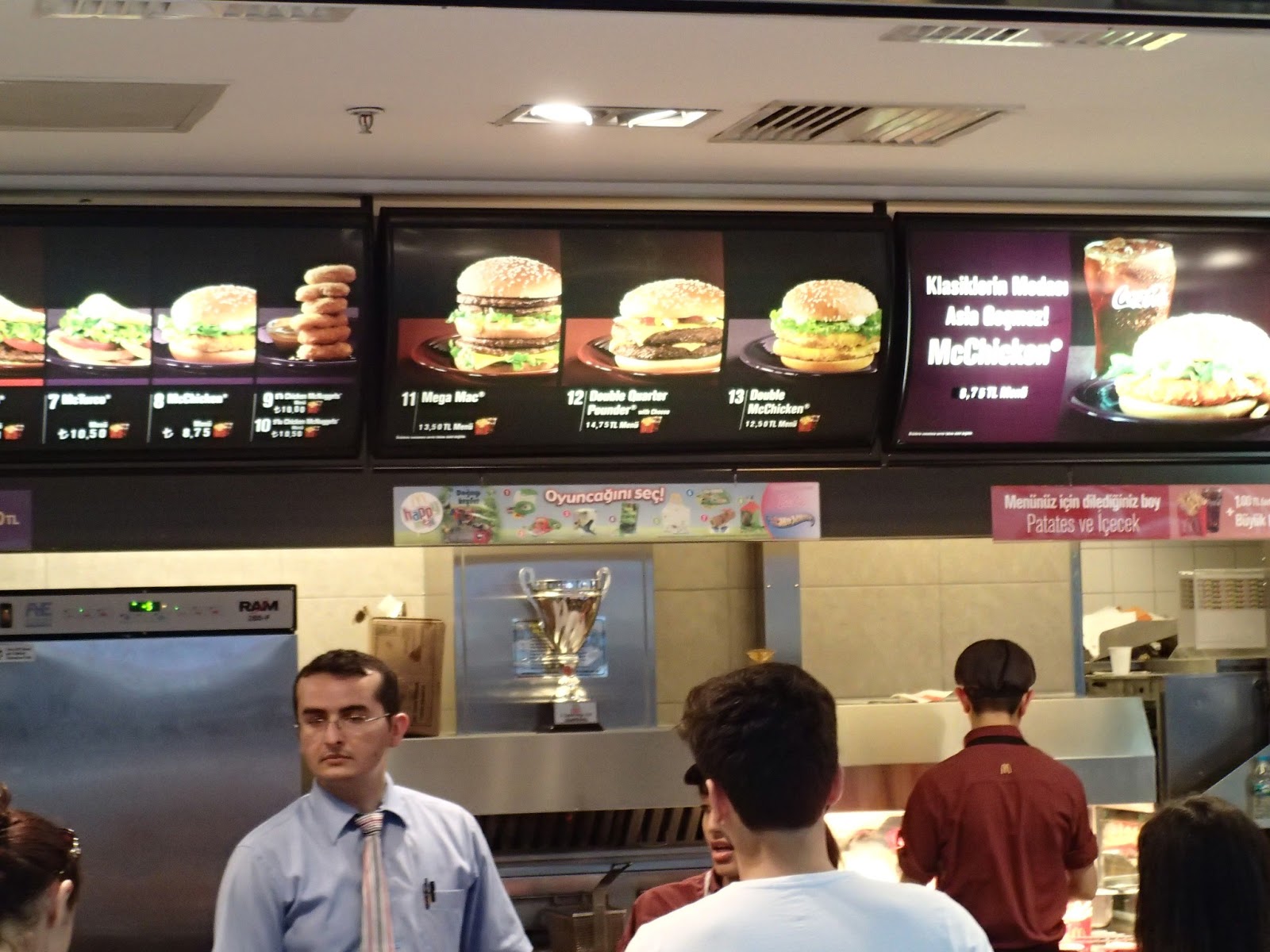
In terms of shopping, this mall had it all from major home appliances to clothing of nearly every brand imaginable. It included team shops for the three most prominent professional soccer clubs in Istanbul. It also featured advertising promoting items that would help to "complete" the perfect middle class lifestyle or even promise elevation in status. All-in-all, it was a very interesting visit that seems to reflect the economic indicators that Turkey's economy has moved millions into a middle class that participates fully in a global consumer society.
Monday, June 24, 2013
A Walk Around Sultanahmet
Here's the route for our afternoon excursions throughout the Old City. This morning, we listened to some remarks about Greek influence, Roman control, and the Byzantine transition of the city that has once been called Byzantion, Constantinople, and now, Istanbul. After lunch, we visited the vast Basilica Cisterns (a vital source of water within the ancient walls of the city), the Hippodrome (home of an Egyptian obelisk and Greek statue commemorating victory over the Persians at Platea), and a small mosque that was originally built as a church during the reign of Justinian prior to his greatest project---The Hagia Sophia. Tomorrow, we will enter the doors of this amazing structure built 1500 years ago!


Finally, here's a picture of the moon rising behind the Blue Mosque. The moon is currently about a large in the sky as it will be for entire year, so it was quite impressive as it emerged from Asian side of the Bosphorus!

Sunday, June 23, 2013
Arrival in Istanbul!
 | |
| View from hotel terrace in Sultanahmet of the Hagia Sophia, the Blue Mosque, and the Bosphorus Strait. |
As one would expect, the Old City is a true labyrinth of narrow streets, small mosques, small restaurants and tea shops, and souvenir stands. This is an area of the city heavily visited by tourists, many from other countries within the larger Middle East. However, despite the crowds near the museums, churches, and mosques, all one has to do is turn into a narrow street or alley to feel as one is stepping out of the 21st century into the Ottoman imperial era.
Tomorrow, our program begins, and we will be stepping back even farther...the era of Constantine and the founding of his city...if only he could see this colossal urban space spanning Europe and Asia today!
Subscribe to:
Posts (Atom)